



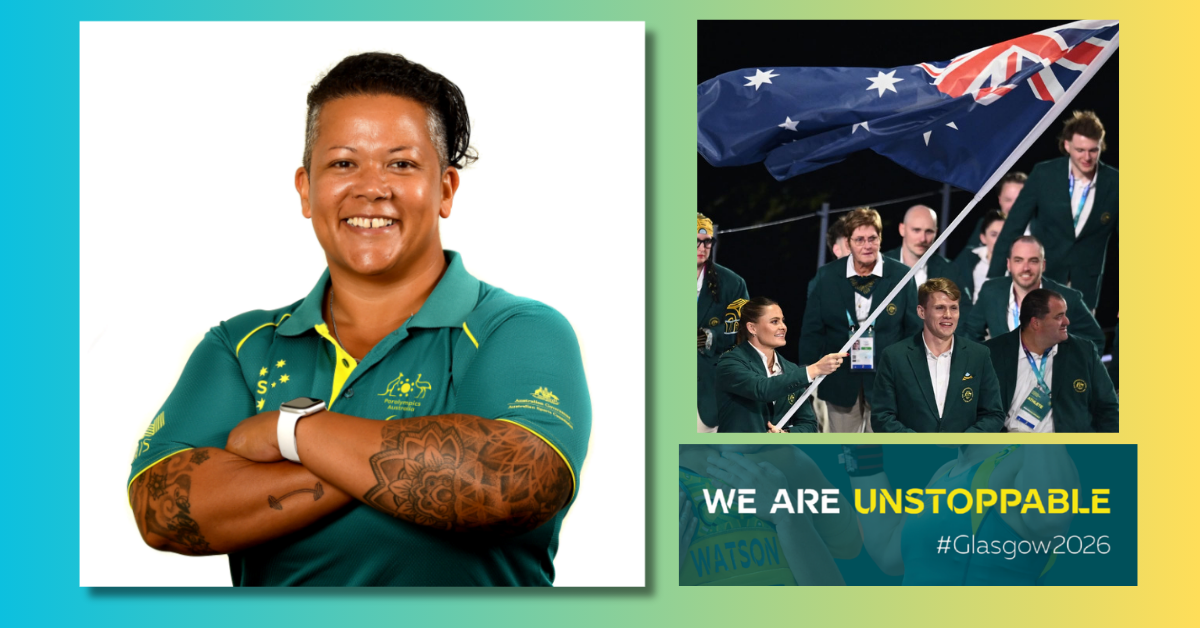
Hani Watson lives with pain every hour of every day. She has even given it a name: Nigel. When the bar reached 147 kilograms at the Glasgow SEC Armadillo Arena, the Hemmant-based para-powerlifter refused to let Nigel win. Watson completed three successful lifts to secure bronze in the women’s heavyweight event, becoming the first Australian para-powerlifter to claim medals at two Commonwealth Games.
Nigeria’s Folashade Oluwafemiayo lifted a world-record 175 kg to win gold. Her teammate Rita Ferdinand took silver after setting a 158 kg world record in the over-79 kg class.

Following the weights set by her coach, Watson opened with 140 kg, cleared 144 kg on her second attempt and finished with 147 kg. Her final result produced a calculated score of 111.5 points.
The Pain She Calls Nigel
Born with bilateral metaphyseal dysplasia—a rare condition affecting the growth of her tibia and femur—Watson’s legs grew severely bowed, resulting in muscle loss, limited movement, and a constant bone-cracking ache.
Watson views naming her pain Nigel as a way to understand it and respond to its warnings. On some days, the pain signals that she can push harder, while on other days, it forces her to stop entirely.
Over the past decade, Watson has endured roughly a dozen major operations, including double osteotomies to reshape her bones, alongside repeated procedures to insert and remove metal support plates.
Her pathway in elite sport has been equally grueling. First seeking classification in 2016, officials initially ruled she did not meet impairment thresholds. Subsequent corrective surgeries altered her mobility, eventually earning her approval to compete. However, another major operation in late 2025 triggered a fresh classification review, leaving her eligibility uncertain until months before the Games.
Her father taught her to find her strength
Before her decisive lift in Glasgow, Watson drew strength from her roots.
Her late father, Charlie—a bodybuilder who bought her a gym membership at age 10—used to playfully curl his daughter like a dumbbell, teaching her early to build her upper body as a special counterweight to her physical limitations. Charlie died when Hani was 17. Her mother passed away in 2023, missing her daughter’s Paralympic debut at Paris 2024.
Born in Auckland with Niuean Polynesian heritage, her birth certificate originally listed the name Hannah before she legally changed it to Hani to connect more deeply with her culture.

That mental fortitude carried her through a brutal 2025. As her pain worsened, Watson spent periods resting with her legs elevated and stayed close to her dogs. Even then, she found humour in the situation. Her legs were struggling, but the bench press didn’t require her to stand.
From Recovery Test to Los Angeles 2028
Powerlifting began simply as a metric to track her post-surgery recovery. Moving from commercial gyms to a specialist facility in Brisbane, Watson quickly broke past her initial 90 kg plateau under expert coaches and safe spotters.
Her career took off swiftly:
- 2020: National champion in the women’s 100kg+ class and Oceania record-holder (130 kg bench press).
- 2022 (Birmingham): Lifted 127 kg to claim bronze, ending Australia’s 16-year Commonwealth Games powerlifting medal drought and becoming the nation’s first female medallist in the sport.
- 2024 (Paris): Finished sixth in the heavyweight event at her debut Paralympic Games.
Now a two-time Commonwealth medallist and the most decorated member of Australia’s six-person para-powerlifting team in Glasgow, the 43-year-old has no plans to slow down. Her sights are set on the Los Angeles 2028 Paralympics, with an ultimate goal to compete on home soil at Brisbane 2032—where she targets a world-record performance at age 49.
Though Nigel will still be present, Watson continues forward, carried by the lessons from her parents, her Niuean pride, and her determination to inspire the next generation of strength athletes.
Published 25-July-2026