
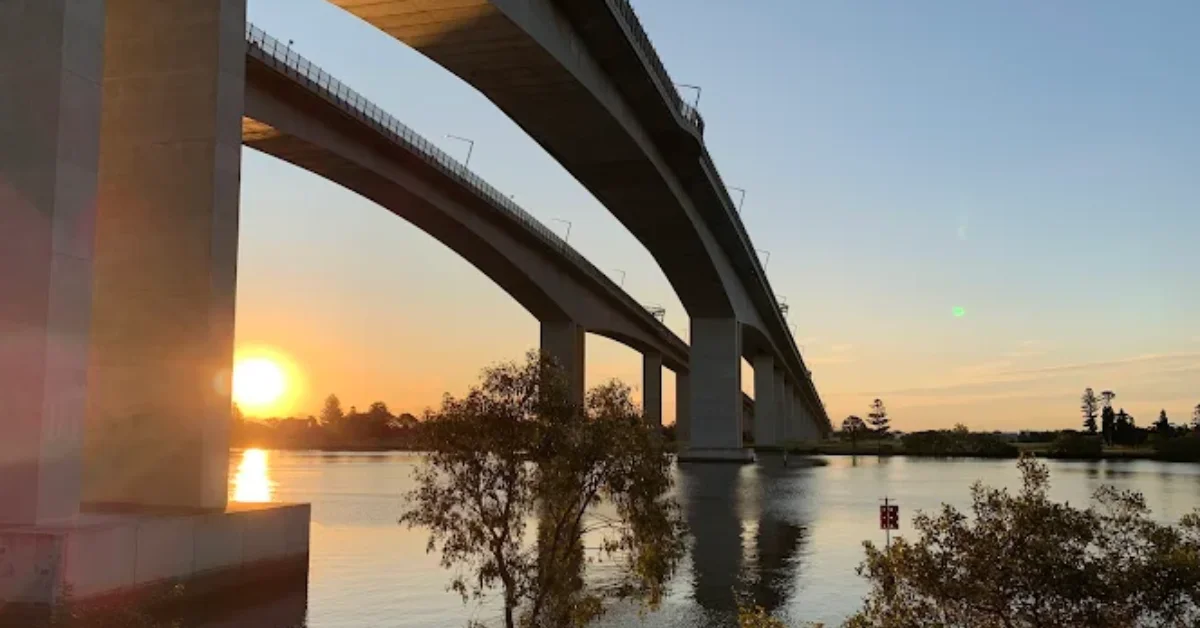
Did you know that the Gateway Bridge, which rises from the riverbank at Murarrie and carries traffic north towards the airport and beyond, was once known as the world’s deadliest bridge? It is a sobering piece of history that the hundreds of thousands of road users who cross it on any given day may not be aware of, yet for a period in its early life, the bridge lived up to that unfortunate title.
Read: Over 1,500 Drivers Want Brisbane’s Tolls Gone — Here’s What It Means for Murarrie Commuters
For residents of Morningside and Murarrie who rely on it for the daily commute north to Brisbane Airport or up to the Sunshine Coast, the bridge is simply part of the daily routine. But as it marks its 40th anniversary this year, its story turns out to be one of the most dramatic in Brisbane’s history.

A solution to a city’s traffic chaos
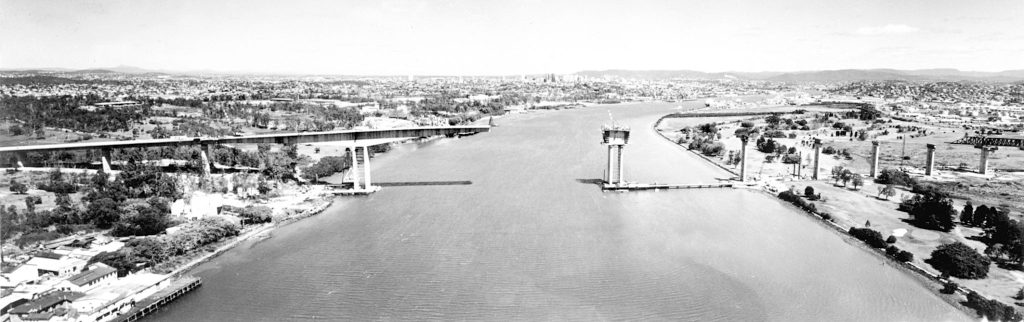
The idea for the bridge took shape in the 1970s, when Brisbane was struggling under the weight of its own growth. Drivers needing to travel between the Gold Coast and the Sunshine Coast had no straightforward way around the city. The options were limited to slow car ferries or lengthy detours through congested inner-city crossings. Freight movements were slow-moving and commuters bore the brunt of it daily.
Roads minister Russ Hinze put forward a plan to fix it. A tunnel was looked at and quickly ruled out as too costly, so the focus shifted to a bridge. Engineers designed a structure high enough for ships to clear underneath, while keeping the deck low enough to stay out of the flight paths into Brisbane Airport, sitting just a stone’s throw from the southern end of the bridge at Murarrie.
Construction stretched over five years and the methods used would raise serious concerns by modern standards. Workers operated high above the Brisbane River in shorts and thongs, often without harnesses or hard hats. Yet the project was completed without any major incidents.
A bridge is born
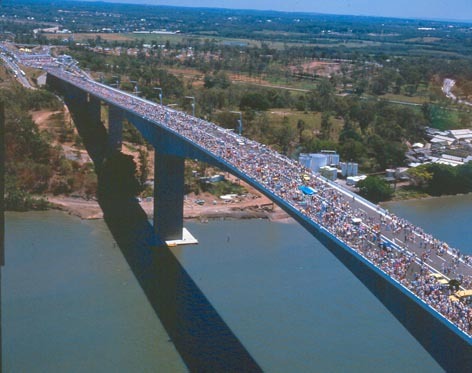
On 11 January 1986, the bridge threw open its doors to the public and Brisbane turned out in force. Around 200,000 people walked across the span in a single day, with blue, yellow and black balloons strung across the structure to mark the occasion. Journalists covering the opening described it as a rare opportunity to experience a world record concrete span up close.
Ordinary Queenslanders were similarly enthusiastic, with many declaring it the finest bridge they had ever seen. Prince Philip arrived four months later to make it official, remarking dryly that he declared the bridge to be more open than usual.
Motorists paid $1.50 for the privilege of crossing. Truck drivers paid $7. Not everyone thought it was worth it. One truckie at the time flatly refused, calling it too expensive.
The years that earned it a darker name
What came after the celebrations was far less uplifting. The bridge had been built with only a low barrier between pedestrians and the drop below, and in the years that followed, it became the scene of more than 120 deaths from accidents and suicides.
A television reporter who broadcast live from the top of the bridge at the time noted for viewers that there were virtually no safety measures in place and that the only thing standing between a pedestrian and a fatal fall was a small wall.
The situation changed in 1993 when proper safety barriers, crisis phones and prevention measures were put in place. Community events including the Bridge to Brisbane fun run later helped welcome people back onto the structure under very different circumstances.
A second span and a new identity
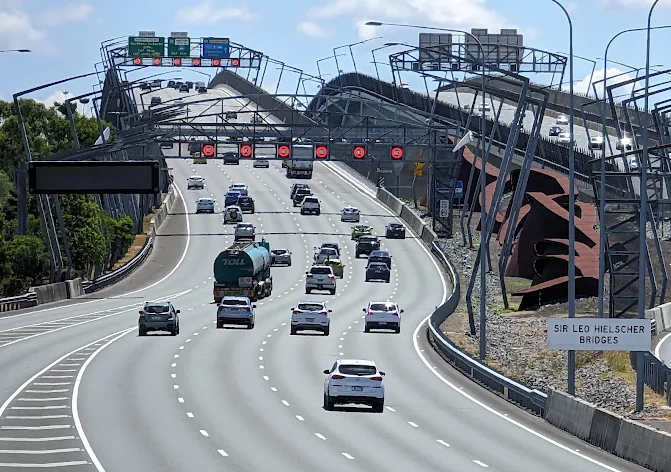
By the mid-2000s the original bridge was struggling to keep pace with Brisbane’s rapid growth. The city had become Australia’s third largest, and six lanes were no longer enough. A second, virtually identical bridge was constructed just 50 metres from the first, opening in 2010 at a cost of around $350 million. The newer span, which includes a pedestrian and cycling path, more than doubled the crossing’s capacity.
Both bridges were eventually renamed the Sir Leo Hielscher Bridges, after the German-born public servant who steered Queensland Treasury for decades. Most locals, however, still call them the Gateway.
Electronic tolling replaced the old toll booths in 2009, and the changeover was followed by a notable drop in crashes. The current toll sits at around $5.50 for cars and closer to $18 for heavy vehicles. Daily traffic across both spans now reaches up to 160,000 vehicles, a far cry from the modest 12,000 or so that used the bridge in its early days.
Read: Gateway Motorway Leads Brisbane’s Lost-Load Incident Count
For Morningside and Murarrie locals, it is easy to take the Gateway for granted. But the next time you head north towards the airport or settle in for the drive up to the Sunshine Coast, it is worth a quiet moment to consider just how far this stretch of concrete has come.
Published 28-April-2026