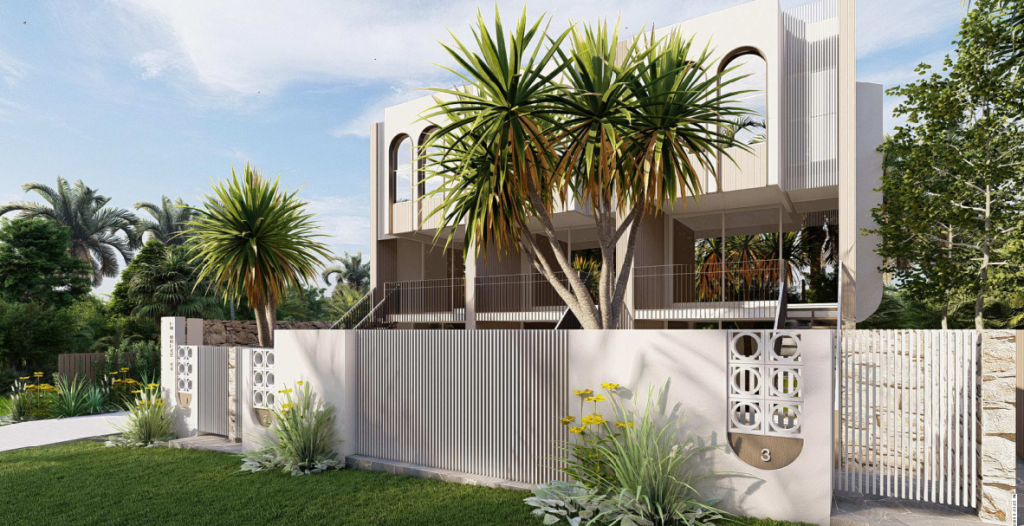


A proposal for an eight-storey residential project has been lodged for 1181 Wynnum Road in Cannon Hill, outlining plans for 96 apartments and a ground-floor retail space.
A development application submitted on 25 November 2025 seeks approval for a multi-residential project at 1181 Wynnum Road in Cannon Hill. A council record created on 28 November 2025 shows the proposal is undergoing impact assessment for a material change of use and building work.
The application lists Red Capital No. 9 Pty Ltd, Red Capital No. 8 Pty Ltd, Kunpeng Investment Holding Pty Ltd, Cannon Hill Investment Holding Pty Ltd and 1181 Wynnum Road Pty Ltd as applicants, with consultant Steffan Harries. The project is also associated with 1177 Wynnum Road. Source material separately identifies Real Capital Pty Ltd as the developer.
Photo Credit: DA/A006909981
Proposed Development Details
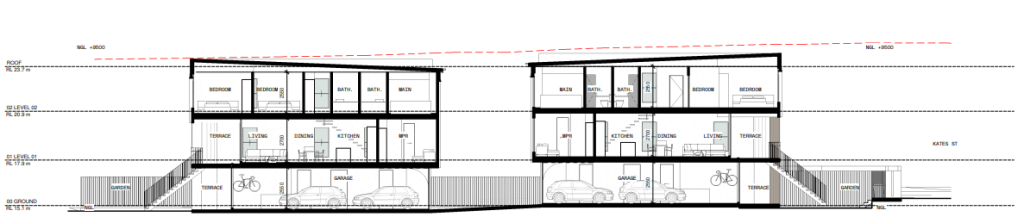
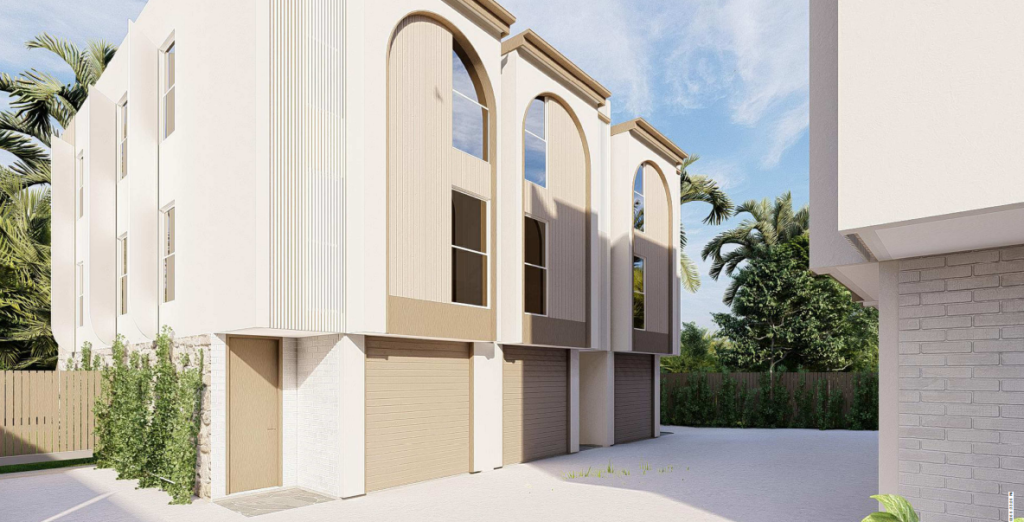
Plans prepared by CPO Architects show an eight-storey building reaching approximately RL38.60 metres. The project includes 96 apartments, consisting of 64 two-bedroom and 32 three-bedroom units, arranged in a consistent layout from levels one to eight.
The design incorporates curved slab edges, vertical screening and landscaping elements.
Photo Credit: DA/A006909981
Parking, Access and Facilities
The proposal includes 161 resident parking spaces and 45 visitor and retail spaces across two basement levels, with 48 bicycle parks also provided. A single retail tenancy is planned for the ground level.
A communal rooftop area includes a pool, spa, gym, dining spaces, barbeque pods, shaded paths and landscaped viewing decks.
Photo Credit: DA/A006909981
Sustainability and Waste Management
Stormwater treatment, passive design elements and façade shading are included. The plans show 1,557 square metres of landscaping and a green façade. No rooftop solar is proposed. Waste facilities include a compactor and baler, with recyclables to be taken manually to the basement.
A Hemmant industrial site is set to transform into a high-tech riverside village under a new proposal that combines boat storage with community lifestyle spaces.
Frank Developments, led by developer Frank Licastro, recently lodged plans for the project known as Brisbane Marina. The proposal targets a three-hectare area zoned for general industry that sits along a 430-metre stretch of the Brisbane River.
The project aims to shift the focus of the eastern riverfront from strictly industrial work to a mix of business, technology, and leisure. The site is located about 15 minutes from both the Brisbane CBD and the Port of Brisbane.
The development plans introduce advanced marine technology to the area. If approved, the marina would be the first in the city to feature autonomous berthing, which allows vessels to dock without manual steering. The scheme also includes a dedicated landing bay for drones and a marine hub equipped for electric vehicles.
Boating facilities are a central part of the design. The precinct is set to offer more than 70 private berths designed for boats ranging from 15 to 20 metres in length. These wet berths will be supported by a ship lift, onsite fuel, and access to shipmaster services 24 hours a day. The site also includes parking for 288 cars to support visitors and workers.
The vision for the site moves away from the look of a standard shipping yard. The design firm BYculprit created a plan that borrows from the style of classic boatsheds. The buildings will feature sawtooth rooflines, bronze-coloured panels, and natural timber to create what the developers call a luxury industrial look.
Frank Licastro noted that the project is designed to be a working village where people can work and relax in the same place. He explained that the city’s waterfronts are evolving into active precincts rather than just industrial edges. To support this lifestyle approach, the plans include 67 workstores of various sizes. The precinct will also feature wellness zones with gyms and saunas, event spaces, and public boardwalks along the river to connect the work areas with the water.
Proposed updates to planning rules affecting Brisbane’s low-medium density residential areas would impact parts of Morningside, aiming to support the delivery of more diverse housing in well-serviced neighbourhoods.
Portions of Morningside fall within Brisbane’s low-medium density residential zone, which represents 14 per cent of the city’s residential land. Construction activity in these areas has slowed sharply, declining from about 1,100 new homes each year to 445 in 2023. Increasing construction costs have made it difficult for smaller townhouse and unit projects in suburbs like Morningside to remain feasible.
A review of planning rules for the low-medium density residential zone proposes several changes intended to enable a wider range of housing options in established suburbs.
Allowable building height would shift from two to three storeys, with some well-located sites near frequent public transport or shops permitted to reach four storeys. Minimum lot sizes would decrease from 260 square metres to 120 square metres to support the creation of smaller blocks.
The proposal also includes simpler development assessment processes and an expansion of subdivision eligibility from 200 metres to 300 metres from shopping centres. Updated design requirements would maintain neighbourhood character through setbacks, maximum building footprints and space for street trees. Parking rates would be adjusted across the city to help lower construction costs.
Why Morningside Is Part of the Review
The review targets well-serviced middle-ring suburbs, specifically those close to shops, public transport and existing infrastructure. Morningside meets these criteria, which is why it appears among the suburbs listed for potential planning updates.
The changes form part of a broader effort to increase housing options in established suburbs rather than expanding outward.
Brisbane is forecast to need around 210,800 additional homes by 2046 due to population growth and shifts in household size. More than half of households consist of single occupants or couples, yet over 70 per cent of existing homes contain three or more bedrooms.
The proposed low-medium density updates could deliver up to 6,000 new homes by 2032 across the city. Morningside is among the suburbs positioned to contribute to this supply through smaller dwellings such as townhouses, units and compact apartments suitable for first-home buyers and downsizers.
Community and Industry Feedback
Industry groups have expressed support for greater housing diversity and improved feasibility for smaller projects. Early feedback from community members highlights ongoing difficulty accessing affordable or appropriately sized homes, with some residents suggesting that expanded housing options in established suburbs may offer relief.
Initial public feedback is being collected through the city’s online platform, with formal consultation scheduled for early 2026.
The proposed changes are undergoing initial review, with community input informing the next phase of planning. The final outcome will determine how areas such as Morningside can support future housing supply while retaining neighbourhood character through updated design requirements.
The incident occurred around 10am in the shopping centre carpark off Creek Road, near the Bunnings store.
According to Queensland Police, the elderly pedestrian was struck by a grey Mitsubishi Triton utility driven by a 24-year-old Carindale man. The pedestrian sustained head injuries and was transported to hospital in critical condition, where he later succumbed to his injuries.
The driver was not physically injured in the collision.
Police investigations into the circumstances surrounding the incident are continuing.
Queensland Police are appealing for anyone with information, dashcam footage, or CCTV from the area at the time to come forward. Witnesses can contact Crime Stoppers to assist with the investigation.
A $2.5 billion redevelopment aimed at restoring the Cairncross Dockyard as a functional shipyard is progressing in Morningside after receiving prescribed project status.
The Cairncross Dockyard was established in 1942 to support naval operations during World War II. The site later declined in use and has been largely dormant in recent years.
In late November 2025, the project was declared a prescribed project, enabling streamlined approval processes for redevelopment works at the Morningside location.
Photo Credit: JarrodBleijieMP/Facebook
Planned Infrastructure and Site Upgrades
The redevelopment involves a privately funded $2.5 billion investment. Plans include a large-scale graving dock, a 6,000-tonne hydraulic chain-jack vertical ship lift, a 1,200-tonne crawler crane and new and expanded wharves. Critical power and water infrastructure will also be developed to support operations.
Once completed, the upgraded facility will allow both on-water and out-of-water vessel maintenance.
Photo Credit: JarrodBleijieMP/Facebook
Expected Economic Impact
The redevelopment is projected to create more than 1,000 direct jobs within the shipyard and thousands of indirect jobs across steel production, advanced manufacturing and logistics.
Interest in the proposal has come from stakeholders in Australia and overseas, including from the United States, Japan and South Korea. The project is being led by Cairncross Dockyard Brisbane Pty Ltd, a subsidiary of Texas Tea Queensland.
Photo Credit: JarrodBleijieMP/Facebook
Community Sentiment in Morningside
Public responses varied, with some comments expressing interest in the dockyard’s restoration. Others noted its historical significance, the need for workforce development and comparisons with other maritime projects in Australia.
Next Steps for the Redevelopment
The prescribed project status allows coordinated assessment and approval processes. The Office of the Coordinator-General will oversee compliance with environmental and social requirements as redevelopment progresses.
Once operational, the upgraded shipyard is expected to strengthen maritime sustainment capabilities and support industrial activity in the Morningside area.
Former gymnast Ava Costa has created a new online platform called The Sharing Shed to help people access specialist disability equipment that might otherwise go unused. Originally from Victoria, Ava moved to Morningside in Brisbane to pursue her gymnastics training, and her recovery journey has now become a way to support others.
Ava’s life changed in April 2023, when she fell from a balance beam during training, landed on her neck, and dislocated vertebrae. The injury damaged her spinal cord and left her dependent on specialised pieces of equipment to carry out many everyday activities. She spent 168 days in hospital as part of her recovery. Once she was discharged, she needed items like a wheelchair appropriate for her size and mobility level, as well as a shower chair, which were essential but not always immediately accessible.
Photo credit: Instagram/Ava Costa
At home, as her rehabilitation progressed, Ava found that many of the expensive items she had relied upon earlier—such as wheelchairs, cushions, or other therapies devices—were no longer required. Rather than letting them sit idle, she and her mother Randi decided to start The Sharing Shed, a network to connect people who have equipment with those who need it.
The Sharing Shed is modelled on a lending-library concept, but for mobility and rehab tools. Through the platform, people can donate, lend, or borrow equipment such as wheelchairs, cushions, and other rehab devices. Since launching, Ava’s family has rehomed her first wheelchair and secured storage space for donated items, aiming to distribute them where they can make the most difference.
The costs associated with rehabilitation are steep. For example, Ava’s functional electrical stimulation (FES) bike reportedly cost $50,000, making such equipment prohibitively expensive for many. By circulating this kind of gear through her sharing network, Ava hopes to lower financial barriers so that more people can access the tools they need.
In addition to its practical purpose, The Sharing Shed aims to build a community of mutual support. It offers a way for people recovering from spinal injuries to connect over shared resources and experience, rather than each navigating the challenges alone. Ava’s own recovery—from being hospitalised to turning her surplus gear into a shared asset—shows how the right equipment, used at the right time, can make a real difference.
Ava’s family hopes The Sharing Shed will expand across Australia, enabling many more individuals with mobility needs to benefit from recycled, donated equipment. For anyone interested in donating or borrowing, the platform provides a practical, community-driven way to give specialist items a second life—and help others on their recovery journey.
Strike Property in Morningside has been recognised nationally after being ranked ninth in SmartCompany’s Smart50 Awards, a program that spotlights fast-growing small and medium businesses across Australia and places a local defence-focused property firm on a national stage.
The Smart50 Awards 2025 were held at Metropolis Events in Southbank, Melbourne, with the ceremony and dinner running from 6:00 p.m. to 10:00 p.m. on Thursday, 13 November. SmartCompany’s Smart50 awards recognise the 50 fastest-growing Australian small and medium enterprises over the most recent three financial years, placing the Morningside business among a select group of high-growth firms from across the country.
The profile on Strike Property reports revenue of $3 million, growth of 79 per cent and a six-person team at its head office.
Defence Veterans Behind the Service
Strike Property was founded in 2022 by two defence force veterans, Dan Irwin and Dane Roche, who saw that defence members and their families were missing out on housing entitlements because the system felt confusing and overwhelming. There were few property businesses with deep, defence-specific knowledge, and that Strike Property began as a way to offer property strategies tailored to the realities of service life, including postings, deployments and frequent relocations.
Its mission is to lay the foundations to build financial freedom through property for the Defence community, their family and their friends. The company supported more than 1,000 property transactions, generating a combined portfolio of over $650 million, reflecting the scale of activity the business now manages for clients.
The Property Investment Professionals of Australia (PIPA) listing for Strike Property confirms that both co-founders are Qualified Property Investment Advisers. This professional accreditation means they follow an industry code of conduct and position the Morningside-based team as specialist advisers for the Australian Defence Force community.
The business focuses on defence-specific education and clear guidance, explaining how those entitlements can be used to support better housing and investment decisions.
In the beginning, people needed to overcome a wider lack of trust in the property industry before it could grow. To address this, the company put transparency and education at the centre of its approach, running programs that step defence client through their options in detail. Over time, positive word of mouth and client-first service helped the business stand out from more generic property offerings and contributed to its steady growth.
Why the Smart50 Award Matters to Morningside
The Smart50 program is designed to elevate and celebrate innovation, growth and community impact among Australian small and medium businesses. Winners receive national exposure through SmartCompany’s coverage and are highlighted as examples of strong performance and business resilience.
On a quiet February morning in 1957, the idyllic suburban life of Cannon Hill was shattered in a storm of violence. By the time the smoke cleared on Narella Street, six people lay dead, and one brave policeman’s quick actions had prevented an even greater catastrophe.
It began like any other day on Narella Street, a dusty strip of modest homes in Brisbane’s Cannon Hill. The children were preparing for school, neighbours were brewing morning tea, and the air was filled with the comforting predictability of suburbia. Then, at 7:30 a.m., the sharp cracks of gunfire broke through the stillness.
Constable John “Jack” Strickfuss, off-duty and enjoying his breakfast just a few doors away, immediately sprang to his feet. A large man with a commanding presence and a reputation for action, Strickfuss grabbed his garden hose and rushed toward the smoke billowing from the Majka household. What he encountered would haunt the community for years to come.
Inside the Majka home, Marian Majka, a Polish immigrant who had survived five years in Nazi labour camps, had snapped. Armed with a .30-calibre American Army carbine, he had stabbed and bludgeoned his wife, Gisela, and their five-year-old daughter, Shirley, before setting the house on fire. But Majka’s rampage wasn’t over.
As flames consumed his home, Majka crossed the street to the Irvine household, where Belinda Irvine and her daughters Annie, 12, and Maureen, 9, were having breakfast with 10-year-old neighbour Lynette Karger. In cold blood, Majka opened fire, killing them all before setting the home ablaze.
Smoke and screams filled the air as neighbours began to realise the enormity of the situation. Strickfuss, undeterred by the chaos, attempted to force his way into the Majka home but was driven back by flames. Then he saw the Irvine house, also burning, and sprinted toward it with neighbours Jim Ainsworth and Fred Ganter.
As the men approached, Majka fired at them, sending bullets whizzing past their heads. One struck the sole of Strickfuss’s boot, but he pressed forward. Ainsworth retrieved Strickfuss’s service revolver, and the constable charged into the inferno through the back door.
What Strickfuss found was devastating. Majka was dead, having turned the gun on himself, but the damage had already been done. In the kitchen, Strickfuss discovered the lifeless bodies of Mrs. Irvine, her daughters, and Lynette, their small forms still smouldering from the fire. Amid the carnage, he heard the faint cries of a baby.
Six-month-old Elaine Irvine was found beneath her mother’s body, her tiny foot injured by a bullet and her hair singed by flames. Wrapping her in a blanket, Strickfuss rushed her to safety, yelling for a taxi to take her to the hospital. His decisive actions saved her life.
Photo Credit: National Library of Australia
The Aftermath of Tragedy
By the end of the morning, six lives had been lost: Gisela and Shirley Majka, Belinda, Annie, and Maureen Irvine, and Lynette Karger. Majka’s motives for the attack were never determined, leaving the community and investigators to speculate on what could drive such violence.
The massacre sent shockwaves across Brisbane, shattering the sense of safety and trust that had defined suburban life in the 1950s. Cannon Hill, once a symbol of quiet family living, became synonymous with one of Queensland’s darkest days.
Heroism Recognised
Constable Strickfuss’s courage did not go unnoticed. For his bravery under fire and his unflinching resolve to save lives, he was awarded the George Medal, one of the Commonwealth’s highest honours for civilian bravery. Neighbours Jim Ainsworth and Fred Ganter received Queen’s Commendations for Bravery for their roles in assisting Strickfuss.
The George Medal is one of the Commonwealth’s highest civilian honours for bravery. Instituted by King George VI during World War II, the medal is granted to individuals who display extraordinary courage in non-combat situations. Constable Strickfuss’s actions that day in 1957 became a defining moment in his career and a symbol of selflessness and duty, reminding the community of the extraordinary sacrifices ordinary people are willing to make in times of crisis.
Photo Credit: National Library of Australia
Elaine Irvine, the sole survivor of the Irvine household, recovered from her injuries and later moved to Adelaide with her father, Neil. The Karger family, however, suffered another heartbreak when Lynette’s mother passed away two years later, unable to bear the weight of her loss.
Photo Credit: National Library of Australia
A Lasting Legacy
More than six decades later, the Cannon Hill massacre remains a grim chapter in Brisbane’s history, remembered both for its senseless violence and for the selflessness of those who risked their lives to protect others. Constable Strickfuss retired as a highly respected sergeant and passed away in 2012, leaving behind a legacy of bravery that continues to inspire.
The events of that day are a stark reminder of how quickly lives can be changed forever, but also of the courage that can emerge in the face of unimaginable tragedy.
Updated 11-November-2025. Originally published 6-Jan-2024
When a violent storm swept through Murarrie, 30-year-old IT professional Manendra Kopparthi stopped to move a fallen branch from the road. Moments later, he was electrocuted by a live powerline hidden in the debris, prompting renewed community discussion about powerline safety during storms.
According to official findings reported in the media, Kopparthi was driving with his wife when he stopped in Murarrie to remove storm debris. Investigators determined that a broken low-voltage line from Energex concealed within the vegetation caused the electrocution. Emergency responders were called, but he could not be revived.
Friends and colleagues described Kopparthi as kind and generous, known for helping others. His wife told the media that he once rescued an injured stray dog not long after their marriage — an act she said reflected his character. Lecturer Anil Naidu, who taught him in a professional course, said Kopparthi often assisted classmates and shared home-cooked meals.
Investigation and safety findings
Queensland’s Electrical Safety Office, which investigated the death, found evidence indicating the fatality resulted from storm impact, rather than vegetation-management issues. Energex said its vegetation checks in the Murarrie area were current and met safety standards at the time.
However, images taken by the media the following day appeared to show branches hanging over nearby powerlines. Energex explained that its maintenance guidelines discourage foliage overhanging low-voltage lines, but allow it in some circumstances when the vegetation is stable and poses no immediate hazard.
Former Energex engineer Ken Millers said he believed current vegetation-clearance standards could be improved, especially given Queensland’s exposure to frequent, intense storms. Energex said it reviews audit findings on an ongoing basis and makes changes where required.
Community and council perspectives
Some Murarrie residents said they had previously raised concerns about large trees dropping branches near industrial properties. Brisbane City Council confirmed residents had asked for inspections in past years, and arborists found the trees in good condition. Council noted that branches can still shed during extreme weather events, even from trees that appear healthy.
Past incidents have drawn similar attention to powerline safety. In 1998, three people died in Ipswich after a storm brought down live electrical wires. Following that tragedy, a coroner recommended exploring options for placing more powerlines underground. It’s a move that remains debated due to significant costs, estimated at more than $50 billion statewide.
Energex restoring power lines following a storm in October 2025 Photo Credit: Energex/Facebook
Energex response and ongoing measures
Energex later replaced the low-voltage lines at the Murarrie location with insulated bundled cables. The company described the work as part of its “routine line replacement program” rather than a specific response to the incident.
In a media statement, Energex said its vegetation-management cycle operates on intervals of up to two years in urban areas, with ongoing audits and safety checks.
An internal audit indicated several high-risk vegetation incidents across southeast Queensland since mid-2023, including cases where plants had contacted or appeared likely to contact powerlines.
Flowers have been tied to the nearby power pole where Kopparthi fell. Residents say they are a reminder of his generosity. Local residents and community leaders have expressed condolences to his family; authorities continue to promote public education on storm-related electrical safety.
At the busy corner of Wynnum Road, Ison Street, and Redfern Street in Morningside, a new traffic signal box now stands as more than just street infrastructure—it’s a vibrant tribute to a much-loved local landmark preparing for a major milestone.
The artwork, titled “100 Years, 100’s of Stories,” was designed especially for the Morningside School of Arts (MSA), which will mark its centenary in February 2026.
Photo credit: Artforce Brisbane
Created by local artist and MSA member Olivia Dean Jones, with participation from MSA president Debra Hood, the artwork weaves together the old and new. Drawing inspiration from the original architectural plans of the 1920s, which was recently rediscovered during a building clean-up, Olivia has reimagined the designs in a bold, colourful way.
Photo credit: Artforce Brisbane
The flowing shape of the Brisbane River wraps around the box, while a stylised image of the Art Deco building takes centre stage, echoing the real-life structure standing proudly nearby.
The project serves as a creative homage to a building that has been central to life in Morningside for generations. It acknowledges the hall’s historical importance while also celebrating its ongoing role as a creative and communal hub.
About the Morningside School of Arts
Photo credit: Morningside School of Arts/Google Maps
The Morningside School of Arts is one of Brisbane’s architectural gems. Designed by Allan Young, the hall was built in 1926 during a time of rapid growth in the area following World War I. Though it no longer operates as a traditional School of Arts, the heritage-listed venue has remained a lively community space, hosting everything from weddings and theatre productions to art shows, dances, and birthday celebrations.
To honour its 100th year, the MSA committee is preparing a commemorative “coffee table” book featuring photographs, memories, and untold stories from locals who have passed through its doors. Community members are encouraged to contribute their own stories via the organisation’s website.
Photo credit: BCC
As part of the countdown to the 2026 centenary, a $250,000 fundraising campaign is also underway to restore and renovate the building. Essential repairs are planned to ensure the hall remains safe, functional, and beautiful for future generations.
More than a piece of public art, the “100 Years, 100’s of Stories” traffic signal box is a symbol of how a neighbourhood can come together to celebrate its history, embrace creativity, and preserve what matters most. In Morningside, it’s clear that the community spirit is alive and well, just as it has been for the past 99 years.